♥
Compassion Lab

Welcome back — here's your lesson, ready to go.

Inspired by the Courage Tales children's book series.

Before & After: Pre-K Learning Check

Start with the BEFORE activity. Teach the Loris story. Complete the AFTER activity afterward. Display or print each scenario.

01 — BEFORE THE STORY

Mia Is Playing Alone

Scenario A · Mia

2–3 minutes

Complete this activity before introducing Loris.

View ActivityPrint

02 — AFTER THE STORY

Noah Is Playing Alone

Scenario B · Noah

2–3 minutes

Complete this activity after the Loris story.

View ActivityPrint

Display each scenario on screen or print it. Children respond aloud, by pointing, or with gestures. No reading, writing, student accounts, or submissions.

Each learning check takes 2–3 minutes. You may complete them separately from the story lesson, including on different days.

How to Use the Learning Checks

Before introducing Loris, show Scenario A and ask the three questions. After the story lesson, show Scenario B and ask the same three questions. Children respond aloud, by pointing, or with gestures.

Teacher observation guide

  • Emotion recognition: Can children name a plausible feeling?
  • Perspective-taking: Can children recognize that more than one explanation is possible?
  • Social response: Can children suggest a respectful action?

These are informal observations only. Nothing is scored or stored, and the activities do not prove learning gains.

Scenario A: Complete before introducing Loris. Read the sentence aloud, show the picture, and ask one question at a time. Children may answer, point, or gesture. Do not assume Mia is sad or left out — she may enjoy playing alone. Accept different ideas.

Scenario B: Complete after the story lesson. Use the same steps and about the same amount of time as Scenario A. Do not assume Noah is sad or left out — accept that more than one feeling or explanation is possible.

For a meaningful comparison: Use approximately the same amount of discussion time and the same question structure for both scenarios. These activities are optional for ordinary classroom use, but teachers participating in the before-and-after evaluation should complete both in the correct order.

Interactive Story Lesson · 12–15 minutes

Begin the Loris story after completing the BEFORE activity.

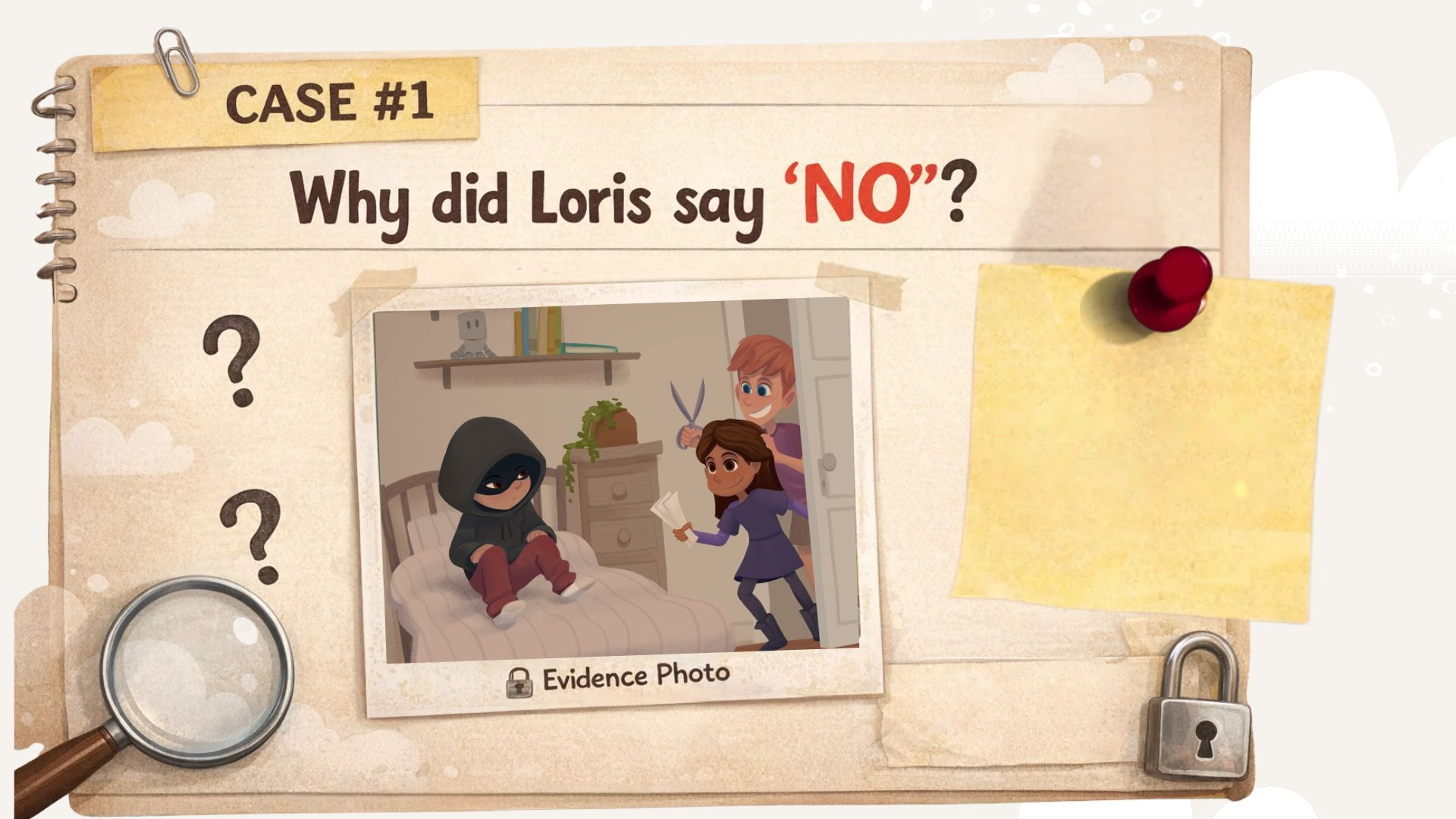
Case #1: Why did Loris say 'NO'? — original webinar slide with the evidence photo of Loris on his bed as two children peek through the door, from Loris Opens Up His Heart

Case open.
Follow the clues.

Pre-K lesson · Ages 4–5

Little Detectives: Why Did Loris Say NO?

Objectives

Noticing feelings, considering why someone might behave a certain way, practising one calming strategy, and choosing a respectful response.

Duration

≈12–15 minutes

Timings are adjustable

Progress

1 / 4 (25%)

Step 1 of 4 · 1–2 min + 3 min video

Meet Loris!

Loris wearing his dark hoodie and holding a red heart against an orange background

“Look at Loris. What do you notice?”

“How do you think Loris might feel?”

“Would you like to play with Loris? Why?”

Teacher tip · Before the video · 1–2 minutes
Children may answer aloud, point, or gesture. Accept different answers. Do not label Loris as unfriendly or dangerous — explain that we can't always know someone's feelings just by looking. Don't reveal the story yet.

Watch Loris's Story

“Let's listen to Loris's story. Listen carefully when he says NO.”

During the video · ≈3 minutes
Play the author-read story. Children simply listen and watch — no counting or writing needed.

Teacher Guide

Materials

  • Classroom screen or projector
  • The three-minute Loris story video
  • Optional printed learning checks
  • Optional emotion picture cards

Before you start

  1. Open the lesson on your classroom screen.
  2. Gather children where they can see the illustrations.
  3. Prepare the video.
  4. No student devices or accounts required.

Facilitation tips

  • Ask one question at a time.
  • Use short, simple sentences.
  • Allow pointing and gestures instead of verbal answers.
  • Give children time to think.
  • Accept multiple plausible emotional interpretations.
  • Avoid forcing children to share personal experiences.
  • Respect children's right to say NO.
  • Model calm and respectful language.
  • Follow existing school procedures if a child becomes distressed.

Optional follow-up: Two-Minute Friendship Practice

Use a puppet or teacher-led role-play. One character invites another to play. The other says NO. Ask children to practise responding respectfully.

  • “Okay, maybe later.”
  • “Would you like to play something else?”

Prototype for customer validation · Original artwork and reading video from Loris Opens Up His Heart · No student data is collected